Furnished vs. Unfurnished for Landlord: Is the Higher Rental Yield Actually Worth the Headache?
If you ask any property agent in KL or Selangor how to maximize your rental income, the advice is almost always the same: “Fully furnish the unit. You can charge RM300 to RM500 more per month.”
On paper, the math looks undeniable. If spending RM15,000 on IKEA furniture allows you to increase rent by RM500 a month, you’ll recoup that investment in 2.5 years. After that, it’s pure profit, right?
Not exactly.
While many new landlords focus purely on the Gross Rental Yield (the monthly rent collected), experienced investors know that the real story lies in the Net Yield—what you actually keep after costs. And the biggest hidden cost in a fully furnished unit isn’t the price of the sofa; it’s the “ambiguity tax” that comes with managing it.
Here is the honest breakdown of the Furnished vs. Unfurnished dilemma that most property gurus won’t tell you.
The “Yield Trap”: Why Higher Rent ≠ Higher Profit
When you rent out an unfurnished (or partially furnished) unit, you are essentially renting out a space. The walls, floors, and fixtures are durable. They don’t break easily, and they don’t go out of style every three years.
When you rent out a fully furnished unit, you are renting out a lifestyle. You are now in the business of providing working appliances, comfortable seating, and stylish decor.
The problem? Lifestyle depreciates. Fast.
That RM3,000 sofa? After two tenancies, it might look tired and stained. That washing machine? It has a lifespan. If you are collecting an extra RM500 a month but spending RM2,000 every year replacing items or repairing appliances, your “extra profit” is quickly eaten up by depreciation.
The Landlord’s Reality Check: In an unfurnished unit, if the tenant wants a better TV, they buy it. In a furnished unit, if the TV breaks, you get a call at 9 PM on a Sunday. You trade potential yield for guaranteed responsibility.
The Hidden Cost of Ambiguity
The previous article we wrote for tenants highlighted how “ambiguity” threatens their deposit. For landlords, this same ambiguity threatens your sanity and your asset protection.
The more items you put into a unit, the more “surface area” you create for disputes.
- Is that scratch on the dining table “damage” or “fair wear and tear”?
- Did the fridge stop working because it’s old, or because the tenant misused it?
- Is the mattress stained enough to justify a deduction?
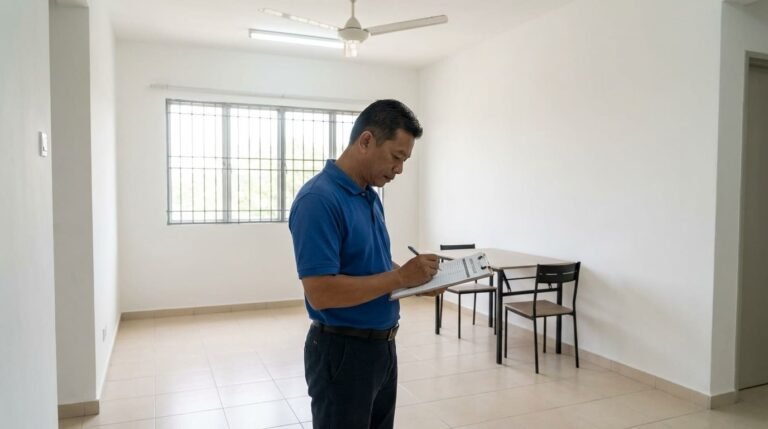
In a sparse, unfurnished unit, the Move-Out Inspection is straightforward. You check the walls, the floors, and the lights. The boundaries of responsibility are clear.
In a fully furnished unit, the inspection becomes a debate. You find yourself arguing over the condition of items you bought years ago. These disputes delay the handover, frustrate both parties, and often result in you absorbing costs just to get the tenant out and the unit re-listed.
Tenant Demographics: Who Are You Attracting?
Your choice of furnishing determines who walks through your door. It acts as a filter for tenant behavior.
The “Fully Furnished” Tenant:
- Who they are: Expats, students, young professionals, or people on short-term contracts.
- The mindset: They value flexibility and speed. They want to move in with a suitcase.
- The risk: Because they don’t own the furniture, they are often less invested in the property. Turnover is generally higher (1–2 years max), meaning you pay agent fees and clean-up costs more frequently.
The “Unfurnished” Tenant:
- Who they are: Families, long-term working professionals, or couples “nesting.”
- The mindset: They value control. They want to bring their own bed because they know it’s clean. They want their own washing machine because they trust it.
- The reward: Moving heavy furniture is a hassle. Once an unfurnished tenant moves their stuff in, they stay. They are statistically more likely to renew their tenancy because moving out is physically difficult.
The Middle Ground: Is “Partially Furnished” the Sweet Spot?
For many Malaysian landlords, the best strategy isn’t all-or-nothing. It’s the “Partially Furnished” approach.
This usually means providing the “White Goods” (essential appliances) and fixtures, but leaving the personal items to the tenant.
- Provide: Air-conditioners, water heaters, kitchen cabinets, curtains/blinds, and maybe a fridge and washing machine.
- Skip: Beds, mattresses, sofas, TV, and dining tables.
Why does this work? It keeps the unit “liveable” enough to attract good tenants but removes the items most likely to suffer wear and tear (mattresses and sofas). It lowers your replacement costs while still commanding a decent rental rate.
The Protection You Need: Why the Agreement Matters
Whether you choose to furnish your unit to chase high yields or keep it bare for peace of mind, the most dangerous thing you can do is use a generic “template” agreement that doesn’t match your property’s condition.
If you furnish your unit, your Inventory List is your lifeline. A vague list that says “1x Sofa” is useless when you need to prove the tenant ruined your RM5,000 designer leather sofa. You need photos, brand names, and agreed-upon conditions signed off at the start.
Furthermore, you need a Maintenance Clause that protects you from “nuisance calls.” A pro-landlord agreement clarifies that while you cover structural repairs (roof, pipes), the tenant is responsible for:
- Regular servicing of air-conditioners (e.g., every 6 months).
- Repairing damage caused by their negligence or their guests.
- Maintaining the interior in a “tenantable condition”.
Conclusion: Know Your Strategy
There is no “wrong” choice, only the choice that fits your investment style.
- Choose Fully Furnished if your unit is in an expat hotspot (like Mont Kiara or KLCC) and you are willing to manage repairs in exchange for higher premiums.
- Choose Unfurnished/Partially Furnished if you prefer stability, lower turnover, and fewer late-night repair calls.
But remember: clarity is cheaper than conflict.
Don’t leave your expensive assets unprotected. At DIY Agreement, our landlord packs are designed to handle these exact scenarios. We provide professional template and clear Maintenance Obligations so that whether your unit is empty or full, your rights are always covered.