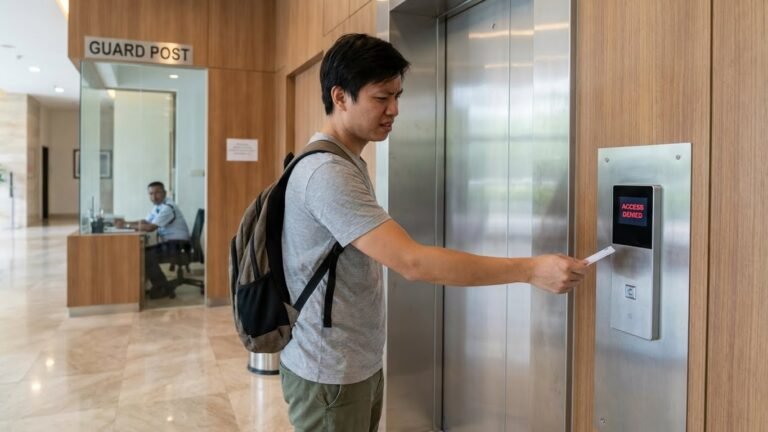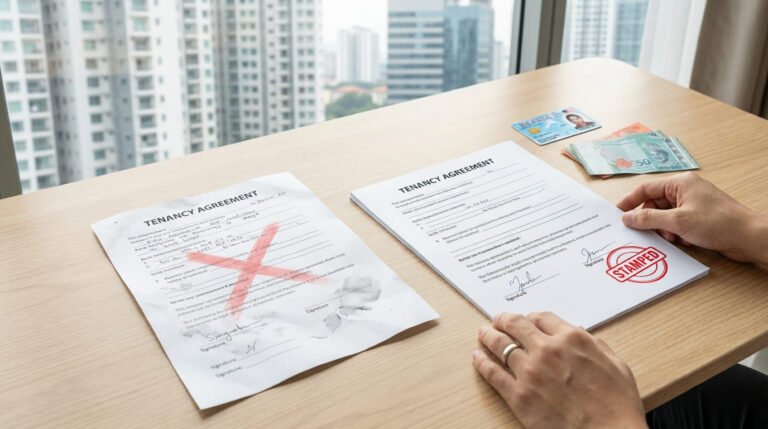
The ‘Ghost Tenant’ Nightmare: Tenant Ran away, but You Still Can’t Just Change the Locks (And What to Do Instead)
It is every Malaysian landlord’s worst nightmare.
It starts innocently enough. The rent is a few days late. You send a polite WhatsApp reminder. One gray tick.
A week passes. You call. No answer.
Two weeks pass. The neighbors tell you the lights haven’t been on, and the mailbox is overflowing.
Panic sets in. You have a mortgage to pay. You start thinking: “I should just drive over there, call a locksmith, break the lock, and take my house back.”
STOP.
Before you touch that doorknob, you need to understand the legal trap you are about to walk into—and how a single clause in your tenancy agreement can save you from a legal disaster.
The Legal Trap: Why You Can’t Just “Take It Back”
In Malaysia, common sense says, “It’s my house, the tenant isn’t paying, so I can enter.”
However, the law says something very different. Under the Specific Relief Act 1950 (Section 7(2)), a landlord cannot retake possession of a property by force without a court order. Even if the tenant owes you three months of rent, if you break the lock and enter without their permission or a court order, the tenant can sue you for trespassing.
This puts landlords in a terrible position known as the “Ghost Tenant” limbo.
If the tenant is truly gone, you are losing money every day the unit sits empty. But if they suddenly reappear claiming they were just “outstation for work” or “visiting a sick relative,” and they find you’ve changed the locks, they have the upper hand legally.
So, how do you protect yourself without breaking the law? You need your Tenancy Agreement to do the heavy lifting for you.
The Problem with “Generic” Templates
Most free tenancy templates you download online are vague. They might say, “If the tenant breaches the agreement, the landlord can terminate.”
But they rarely define what “abandonment” actually looks like.
If your tenant disappears for 2 weeks, is that abandonment? What about 3 weeks? Without a clear definition, it is your word against theirs. If you go to court to apply for a distress order or eviction, the judge might ask: “How did you know they abandoned the unit? Maybe they were just on holiday.”
If you cannot prove they abandoned the property, your legal case stalls. This is why ambiguity is expensive.
The DIYa Solution: The “30-Day” Rule
This is exactly why we created the DIYa Pro-Landlord Agreement. We don’t rely on guesswork; we rely on specific definitions that protect your investment.
In our Pro-Landlord Edition, we include a specific “Abandonment Clause” in Section 18.1(c). It states that a “Default” has occurred if there is:
“Abandonment of the Premises, or leaving the Premises unoccupied for more than thirty (30) consecutive days without providing prior written notice to the Landlord.”
Why is this clause a game-changer?
- It Removes Ambiguity: You don’t have to guess if the tenant has left. If the unit is empty for 31 days and they haven’t told you, they have officially breached the contract.
- It Creates “Material Breach”: Once this 30-day mark is hit, Section 18.2 of our agreement explicitly gives you the right to terminate the agreement and forfeit the Security Deposit to cover your losses.
- It Strengthens Your Court Case: When you file for a court order (which you still should do to be 100% safe), you can present the agreement and say, “Your Honor, under Section 18.1(c), the tenant contractually agreed that 30 days of absence equals abandonment. Here is the proof they have been gone for 31 days.”
This turns a messy “he-said-she-said” argument into a clear-cut breach of contract case.
What To Do If Your Tenant Ghosts You (Step-by-Step)
If you find yourself in this situation, follow this checklist to stay on the right side of the law:
1. Check Your Inspection Rights You cannot barge in, but you can inspect. Under Section 7.1 of the DIYa agreement, you have the right to enter for inspection provided you give 12 hours’ notice.
- Tip: Send a WhatsApp and tape a notice to the door. Even if they don’t reply, you have proof you followed the notice period required by the contract.
2. File a Police Report Go to the nearest police station. Report that the tenant is uncontactable and you suspect the property has been abandoned. This is not for the police to take action, but to create an official paper trail that you are acting in good faith.
3. Wait for the “30-Day” Trigger If you are using the DIYa Pro-Landlord template, document the vacancy. Once that 30-day window passes without notice from the tenant, Section 18.1(c) is triggered.
4. Issue a Notice of Termination Send a formal notice citing the breach of Section 18.1(c). State that the agreement is terminated and the deposit is forfeited as per Section 18.2.
5. Apply for a Court Order With your agreement and police report in hand, engage a lawyer to get a Distress Order (to recover rent via the tenant’s goods) or a Writ of Possession (to legally recover the house). Because your agreement clearly defines the breach, this process is often smoother and faster.
Don’t Leave Your Investment to Chance
The difference between a nightmare eviction and a managed process is often just a few lines of text in your contract.
If you are using a generic template that doesn’t define “Abandonment,” you are leaving a loophole for bad tenants to exploit. Don’t wait until the tenant disappears to find out your contract is weak.
Protect yourself today with the DIYa Pro-Landlord Tenancy Agreement. It’s bilingual (English & BM), fully editable, and designed to handle the real-world problems Malaysian landlords face.